
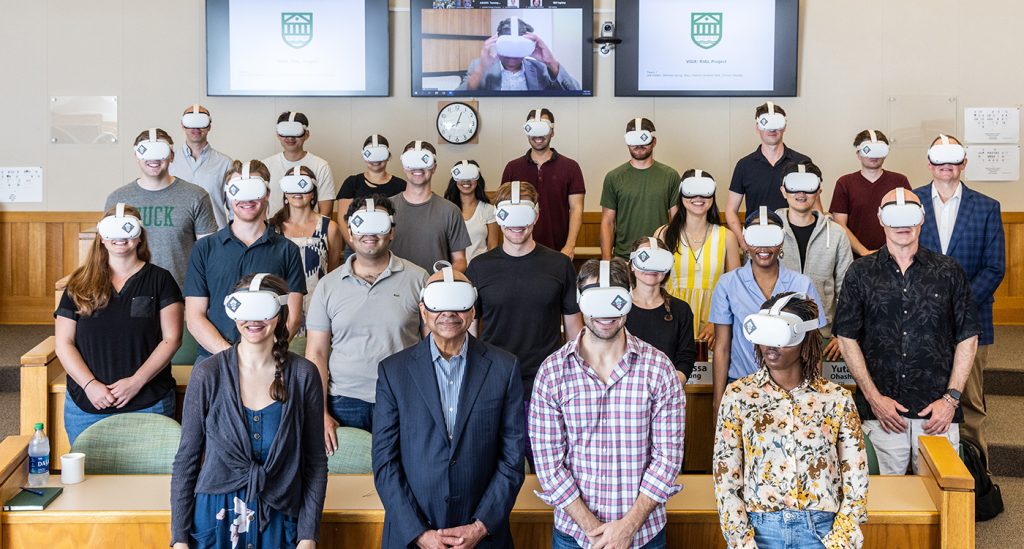
In the summertime of 2021, when the COVID-19 pandemic created uncertainty about journey restrictions and Tuck’s potential to ship college students overseas on International Perception Expeditions (GIXs), Vijay Govindarajan, the Coxe Distinguished Professor of Administration, sensed a possibility for innovation.
Throughout his 40-plus years of educating strategic innovation to MBA college students and executives, he has realized that unpredictability is a type of present to innovators, as a result of it prompts them to dream about what may come subsequent. Taking that cue from his personal educating, Govindarajan imagined a GIX that reversed the outdated framework: as an alternative of bringing college students to a international nation, Tuck would carry the international nation to Hanover, utilizing virtual-reality and video know-how. He pitched the thought to Dean Matthew Slaughter, framing it as an experiment and a hedge towards the idea that typical GIXs would proceed as deliberate within the spring of 2022.
By January of 2022, Govindarajan’s wager had paid off. The Omicron variant was spreading quickly the world over, and the Deans’ workplace determined to cancel all six of the GIX journeys that have been scheduled to occur in March. Govindarajan had spent six months creating his Reverse Innovation Digital Perception Expedition to Tamil Nadu, South India, considering that he’d have 20 college students. With the common GIXs canceled, enrollment surged to 30. “That is the ability of strategic resiliency,” Govindarajan says. “We experimented on the edges, and that allowed Tuck to pivot seamlessly to a VGIX.”
Govindarajan didn’t intend to exchange conventional GIXs with digital programs. He wished to discover the potential of digital know-how to reinforce and remodel the educational expertise in all realms of the MBA program and Tuck government schooling. “Tuck will at all times be a residential program,” he says. “That’s the gold normal. I wished to see if we may embed some diamonds into that gold normal and make the residential expertise even shinier.”
What does a diamond-studded MBA expertise seem like? For Govindarajan, it begins with the philosophy that enterprise has an necessary position to play in serving the billions of low-income individuals in creating international locations who’ve largely been ignored by capitalism. He addresses this concern in his idea of Reverse Innovation, which posits that companies can innovate for creating markets, revenue from them, after which take these improvements to developed markets and revenue much more. The VGIX brings this concept to life by difficult college students to conceive of a private well being and wellness downside in South India that enterprise may handle and that might ultimately be delivered to, say, the U.S. or Europe.
A enterprise downside is at all times embedded within the cultural context. When you don’t perceive the tradition and social life of those individuals, you gained’t perceive their issues with private well being and wellness.
—Vijay Govindarajan
Govindarajan is aware of Reverse Innovation for South India can’t occur fully in an workplace constructing in New York or London. “A enterprise downside is at all times embedded within the cultural context,” he says. “When you don’t perceive the tradition and social life of those individuals, you gained’t perceive their issues with private well being and wellness.” The corollary is that Reverse Innovation is more likely to achieve success if a agency units up a satellite tv for pc workplace within the South India metropolis of Chennai. With the VGIX, Govindarajan is testing if there’s a hybrid strategy. Particularly, he created a didactic market-research system that blends idea, apply, and know-how.
The course begins with a lesson on Reverse Innovation from Govindarajan. Within the second session, college students meet an entrepreneur who has efficiently executed Reverse Innovation in India, inventing an reasonably priced system that screens for cataracts and glaucoma, and which is now being bought within the U.S. Classes 4 via seven are dwell buyer interviews, and the scholars put together for them by doing asynchronous cultural, historic, and sociological studying, by way of textual content and video; and by watching virtual-reality movies with Oculus headsets that give them a 360-degree sense of the panorama and communities in South India. Within the closing three weeks of the course, college students kind groups and work on action-learning initiatives. With the assistance of management and cross-cultural coach Maarten Asser, the groups discover depraved health-and-wellness issues that enterprise can remedy, after which pitch their concepts to Indian enterprise capitalists. “One of many issues I attempt to train the scholars is to critically study their assumptions,” Asser says. “When you’re assumption is mistaken and doesn’t match the tradition and way of life, then you definitely miss your goal by lots.”

As a part of the course, the scholars carried out dwell buyer interviews with 4 households on the base and center of the financial pyramid, in each rural and concrete communities.
Govindarajan hales from India and appreciates its vastness and variety. He designed the course to spotlight a few of this variety by specializing in 4 households on the base and center of the financial pyramid, in each rural and concrete communities. Taken collectively, these households are consultant of greater than 800 million potential shoppers in India, which brings the dimensions essential to spur profit-minded innovation. The households embody hunter-gatherer-style fishermen in Vadapattinam; building laborers in Kovilambakkam; a company worker within the middle-income neighborhood of Vettuvankeni; and a farmer and social employee in Koovathur.
Even with out a bodily presence in India, we nonetheless felt emotionally linked with the individuals we spoke to. I realized that empathy and respect are actually necessary to be an issue solver on this planet. It was a life altering expertise for me.
—Yuta Ohashi T’22
None of this is able to have been attainable with out Mahesh Sriram, an experiential journey skilled primarily based in Chennai. Sriram met Govindarajan about 17 years in the past, whereas Govindarajan was engaged on the Tuck International Management government schooling program. For the previous 16 years, Sriram and his staff at I-India Management and Improvements have been designing and delivering the sphere experiences and applications in India and China for the International Management program; collectively, they’ve greater than 50 years of expertise working for Tuck government schooling. Their activity for the VGIX was to create movies and VR experiences that allowed college students to develop empathy for the households they have been going to interview, and to incorporate a story arc to the content material that gave the scholars clues to a number of the well being points the members of the family endure.
“What we’ve got realized is we are able to do some very goal, immersive movies that transfer you from Hanover to India, and inform you concerning the historical past, geography, tradition, surroundings, schooling, and financial system,” Sriram says. “And we are able to do that second stage of tales, the place characters are going via conditions. Furthermore, we are able to produce VR movies that permit college students to be invisible and simply watch and hearken to what’s occurring. This offers them the identical feeling as if they’re visiting that village.”

This can be a enormous manufacturing activity, full with I-India employees on location in India, utilizing conventional 2D video cameras, superior 360-VR cameras with encompass sound, and infrequently taking pictures within the topics’ properties—a time consuming course of to teach them about 360 and VR, get their consent, after which seize what they’re seeing and listening to. “The VR scenes are a unique kind of storytelling,” Sriram says. “The story needs to be current within the ambiance, and it’s a must to seize the best frames.” One of many VR scenes places college students on the seashore in Vadapattinam, the place they see and listen to fisherman at work, and fishmongers and households conversing in Tamil. In one other scene, college students can stroll with locals to a nook retailer in an city neighborhood in Kovilambakkam, see the homes, wagons, and puddles, and spot how individuals purchase requirements like cleaning soap in small packets, as a result of they’ll’t afford bigger sizes.
Whereas these distinctive home windows into life in India have been impactful for college kids, the client interviews have been really transformational. For Yuta Ohashi T’22, who’s initially from Japan, the direct interplay with households was the spotlight of the course. By talking with all of the households, he realized that well being and wellness issues stem from lack of know-how, entry, and affordability. He noticed this, for instance, within the fishermen who discounted the damaging well being results of years spent within the vibrant solar on the ocean and informed how they’ll’t go to the hospital for care as a result of it’s too costly. He additionally realized that diabetes is a typical ailment in India, and observed that each low-income and middle-income individuals endure from it, however the illness has completely different pathways for every class. “The bottom-of-the pyramid individuals don’t have any choices for diet,” he explains. “They need to eat what they’ll afford, or what’s offered by the federal government. The center-of-the-pyramid individuals have a alternative, however they want to eat low cost, unhealthy meals.” Ohashi and his action-learning staff proposed the thought of elevating consciousness and entry to nutritious meals, and to start out by having groups visits faculties and rating them on diet, so they may determine areas to prioritize. “Even with out a bodily presence in India, we nonetheless felt emotionally linked with the individuals we spoke to,” he says. “I realized that empathy and respect are actually necessary to be an issue solver on this planet. It was a life altering expertise for me.”
By being empathetic, listening to individuals and never judging them, it despatched the dialog in an entire new path.
—Fatmah Ba T’22
Fatmah Ba T’22 enrolled within the VGIX as a result of she wished to spend a part of her MBA expertise exploring an rising nation. Ba is from Senegal and hoped to carry classes from the VGIX again house someday to assist remedy well being and wellness issues there. She appreciated how open the individuals have been of their interviews, and she or he discovered it fascinating that folks in India and extra developed international locations generally share the identical well being points, comparable to poor diet. “By being empathetic, listening to individuals and never judging them, it despatched the dialog in an entire new path,” she experiences. Her action-learning staff hypothesized that low-income Indians are conscious of the advantages of wholesome consuming however can’t afford meals which are wealthy in protein and nutritional vitamins. Based mostly on studying that the interviewees purchase small sachets on the nook retailer, Ba’s staff proposed reproducing that mannequin with packets of seasonings or drink mixes fortified with nutritional vitamins and proteins. “Pitching this to the VCs was an ideal expertise,” she says. “They appreciated our thought as a result of sachets are one thing persons are already utilizing in distant areas. In addition they pushed us to consider a enterprise mannequin, and we proposed promoting the dietary supplements to ladies’s self-help teams, who may then promote the packets by way of word-of-mouth.”
Related posts:
 Digital actuality offers people a turtle’s-eye view of wildlife
 Mark Zuckerberg envisions 1 billion folks within the metaverse
 Meditating in Digital Actuality Nature With a Picos Headset
 The International Metaverse Market in 2030 will likely be price USD 1.6 trillion, having a CAGR of 38.25%.
 VR and AI-powered chatbots – SupChina
 10 metaverse risks CIOs and IT leaders ought to tackle
 Engineering College students Create Digital Actuality System
 Shangri-La designed to showcase that “folks energy is feasible”