
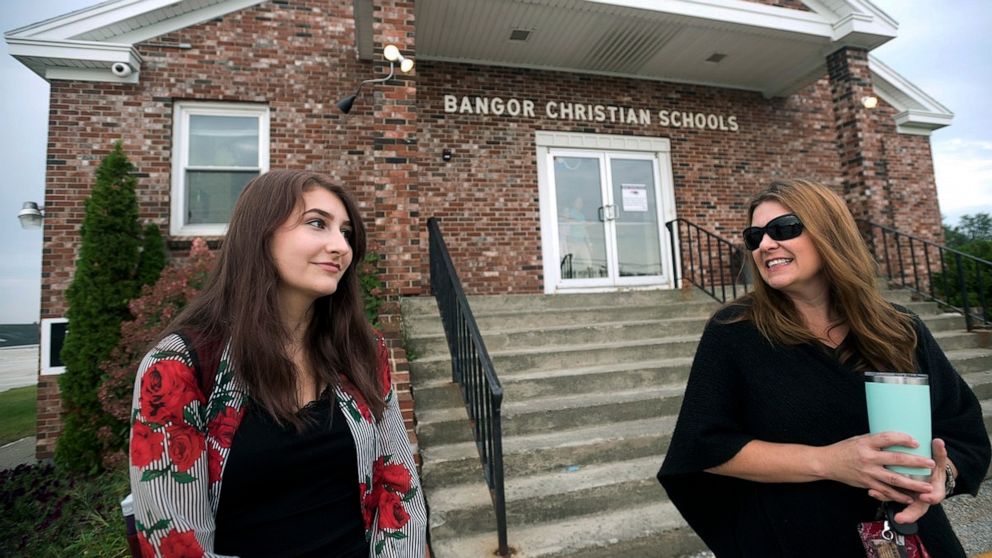
AUGUSTA, Maine — Spiritual colleges acquired what they needed when the Supreme Court docket allowed them to take part in a state tuition program.
However the state lawyer common stated the ruling can be for naught except the faculties are keen to abide by the identical antidiscrimination legislation as different personal colleges that take part in this system.
An lawyer for the households criticized the “knee-jerk” feedback, and the chief of a spiritual group predicted additional litigation.
The Supreme Court docket dominated Tuesday that Maine cannot exclude spiritual colleges from a program that gives tuition for personal schooling in cities that don’t have public colleges. However spiritual colleges did not have lengthy to savor their victory earlier than studying of a brand new hurdle.
Legal professional Normal Aaron Frey stated each Christian colleges concerned within the lawsuit have insurance policies that discriminate towards college students and workers on a foundation of sexual orientation or gender id, stopping their participation within the tuition program regardless of the hard-fought litigation.
“The schooling offered by the faculties at situation right here is inimical to a public schooling. They promote a single faith to the exclusion of all others, refuse to confess homosexual and transgender youngsters, and brazenly discriminate in hiring academics and workers,” he stated in a press release.
There was no speedy remark from two colleges, Temple Academy in Waterville or Bangor Christian Faculties.
Michael Bindas, senior lawyer for the Institute for Justice, stated the lawyer common isn’t paying shut consideration to the Supreme Court docket’s dedication to non secular liberty lately.
“It was an faulty opinion of the Maine lawyer common that embroiled the state in 5 lawsuits spanning three a long time and that culminated within the Supreme Court docket’s ruling towards the state,” Bindas stated Thursday in a press release. “The present lawyer common appears to not have realized any classes from that have.”
If the state really intends to make use of the state legislation to create one other impediment, then extra litigation can be inevitable, stated Carroll Conley, govt director of the Christian Civic League of Maine.
The unique lawsuit by three households searching for reimbursements to attend Christian colleges dates to 2018, nevertheless it goes again even additional.
The state all the time sought to take care of a stable line between church and state by reimbursing for personal colleges — however not spiritual colleges. The objective was to present rural college students with out a public highschool an schooling that’s just like what public college college students get.
In Maine, 29 personal colleges take part in this system, enrolling 4,526 college students, officers stated. Personal colleges that meet the state’s standards can get about $12,000 in taxpayer funding per pupil.
Essentially the most speedy impact of the court docket’s ruling past Maine in all probability can be in close by Vermont, which has an analogous program.
The Supreme Court docket’s 6-3 determination may propel college alternative pushes in a few of the 18 states that haven’t directed taxpayer cash to non-public, spiritual schooling. It was seen as an affirmation for states that have already got voucher packages open to non secular colleges.
However all colleges receiving state tuition should abide by the Maine Human Proper Act, which bans discriminating towards somebody due to their race, gender, sexual orientation, ethnicity or incapacity, Frey stated.
The Legislature within the final session strengthened the legislation that clarified the scope of the Maine Human Rights Act in schooling. Democratic Gov. Janet Mills signed the invoice into legislation final 12 months.
The up to date legislation, sponsored by Democratic Sen. Craig Hickman, the primary brazenly homosexual African American to serve in each chambers of the Legislature, bans discrimination in schooling on the idea of “intercourse, sexual orientation or gender id,” amongst different issues.
The American Affiliation of Christian Faculties, in the meantime, brushed apart considerations of discrimination towards the LGBTQ neighborhood.
“We don’t have a look at it as discrimination in any respect. We’ve a set of ideas and beliefs that we consider are conducive to prosperity, to the great life, so to talk, and we associate with mother and father who share that imaginative and prescient,” stated Jamison Coppola, spokesperson for the affiliation.
The lead plaintiffs, Dave and Amy Carson, have been college students of Conley when he was headmaster at Bangor Christian Faculties.
Conley stated the lawyer common “laid down the gauntlet” for spiritual colleges, however he stated authorized precedent favors the faculties.
Dave Carson, for his half, stated his household will not profit from the ruling as a result of his daughter is already a junior at Husson College. However he stated he does not suppose it is proper for the state to attempt to put up roadblocks.
“So long as it’s an accredited college, college students ought to be capable of go wherever they wish to,” he stated. “You’re educating the fundamentals. If you wish to have a Bible class, too, then that is a mother or father’s alternative, not somebody down in Augusta.”
Bindas stated the lawyer common ought to undertake a “sober reflection” of how finest to steadiness the rights of fogeys within the litigation versus the state’s anti-discrimination pursuits.
“It’s doable to develop insurance policies that respect the considerations of each advocates for LGBTQ rights and advocates for spiritual liberty, however provided that elected officers are genuinely dedicated to that process,” he stated.
———
Related Press author Collin Binkley in Boston contributed to this report.
———
Observe David Sharp on Twitter at
Related posts:
 People Have Shut however Cautious Bond With Their Smartphone
 Housing help applications in Chester County awarded greater than $2.8 million – Every day Native
 Monadnock Ledger-Transcript – Sununu publicizes energy-assistance program as charges are set to double
 Nigeria’s newest lithium discover: some key questions answered
 World IoT Microcontroller Market Dimension, Share & Business Traits Evaluation Report By Sort, By Utility, By Regional Outlook and Forecast, 2022
 Tech program helps folks launched from jail be taught laptop abilities
By System Sort, By Streaming Sort, By Utility, By Income Stream, And Area – International Evaluation of Market Dimension, Share & Traits For 2019–2021 And Forecasts To 2031
Tech program helps folks launched from jail be taught laptop abilities
By System Sort, By Streaming Sort, By Utility, By Income Stream, And Area – International Evaluation of Market Dimension, Share & Traits For 2019–2021 And Forecasts To 2031
 OIG Advisory Opinion On The Federal Anti-Kickback Statute