
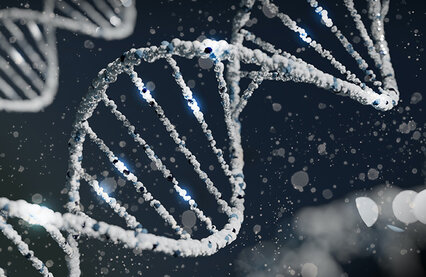
Scientists in a brand new USC Dornsife division focus on the mysteries inside and ethical points surrounding our DNA.
In short:
- School within the newly established USC Dornsife Quantitative and Computational Biology Division are investigating a wide range of totally different issues, from mapping lacking sections of DNA to understanding the genetics shared amongst inhabitants teams.
- They’re additionally making sense of a number of the ethical questions surrounding genetics — like whether or not DNA databases ought to be used to find criminals.
Inscribed inside our cells may very well be our future, a narrative written earlier than we’re even born.
Inside every cell of the human physique, an individual’s genes comprise directions that affect traits like top, eye coloration, and even whether or not or not we just like the style of cilantro. And variations in our genes can alter our danger for sure ailments, similar to breast most cancers and schizophrenia.
In fact, it’s not fairly this easy; many components play a job. Some genes are solely “activated” underneath sure environmental circumstances. Upbringing or cultural forces can overcome genetic predispositions, in lots of instances, although scientists aren’t sure to what extent.
Researchers on the new Division of Quantitative and Computational Biology (QBIO) on the USC Dornsife School of Letters, Arts and Sciences are utilizing superior math and laptop science to reply a number of the necessary questions surrounding our genes, and the future they foretell.
The tradition in QBIO emphasizes superior computing and collaboration, aiming to foster an excellent atmosphere for discovery. At different universities, many of those students could be the one computational researcher of their division. Right here, they’re surrounded by them.
“In QBIO, if I run right into a computational drawback, I can simply stroll down the corridor and discuss to somebody,” says Michael “Doc” Edge, assistant professor of Quantitative and Computational Biology. “I can really develop my work this manner.”
Discovering the lacking hyperlink

Michael “Doc” Edge. (Picture: Courtesy of Michael Edge.)
In 2003, scientists sequenced the majority of the human genome for the primary time, revealing all of the letters of code in our DNA. It price a couple of billion {dollars} and over a decade to finish. Since then, advances in expertise have reduce down the hassle significantly. It might take mere weeks and round $1,000 to do that identical work in the present day.
The expertise that may presently produce a genome at this worth does have drawbacks: Some 3% of the human genome can’t be interpreted utilizing this expertise. But, these lacking sections could comprise genetic variations that might inform us a lot about ourselves.
“If we wish to predict how somebody’s genome will have an effect on how they reply to a drug, or how seemingly they’re to develop a selected illness, if we’re lacking some fraction of it as a result of we’re utilizing this shorter-read expertise, then we’re not seeing the total image,” says Mark Chaisson, assistant professor of quantitative and computational biology.
Chaisson’s lab is growing highly effective, intricate strategies so as to add that lacking proportion again in. As soon as the hole is crammed, Chaisson and his college students can discover extra details about genetic variation and the way it may contribute to inherited ailments.
A lot of his work is especially centered on structural variants, which happen throughout a big swath of the DNA sequence fairly than only a single, small level.
A lot of his work is utilizing large-scale research and big databases, which implies the highly effective computer systems on-hand at QBIO are very important to his analysis — as are his colleagues.
“All the things that we produce is both the results of an individual sitting on the laptop themselves, or chatting with one other particular person right here and studying some new talent or sharing concepts,” says Chaisson.
Advanced genetics

Mark Chaisson. (Picture: Courtesy of Mark Chaisson.)
Over in Edge’s lab, he and his college students are researching “complicated traits,” traits that come up from a mix of each genetic variation and behavioral components and environmental circumstances.
As an illustration, an individual’s top is influenced by a whole lot of genetic variants, and it’s how these variants mix collectively that dictate how tall somebody grows. Top can also be closely influenced by diet, nevertheless. An individual with genetics which may usually have them pushing 6 toes may find yourself shorter resulting from insufficient diet.
Edge additionally research points surrounding genetics and privateness. A current rise in residence shopper genetics exams, used to discover one’s ancestry or propensity for sure ailments, has resulted in huge databases of genetic info
Legislation enforcement officers and consultants are additionally more and more looking a subset of those databases utilizing DNA taken from crime scenes, a technique dubbed “forensic genetic family tree.” California’s Golden State Killer, who murdered at the least 13 individuals and had been hunted because the Seventies, was lastly recognized in 2018 because of this form of search.
Edge has written each in regards to the energy of this type of detective work and in regards to the privateness considerations it raises. An individual who uploads their private genetic take a look at to an ancestry database unwittingly uploads details about all of their kinfolk who share their genes.
“While you add a take a look at, it doesn’t simply have an effect on you; it doubtlessly impacts a bunch of individuals you’re associated to, a lot of whom you’ve by no means even met,” says Edge. The principles round these searches are presently enforced solely by the person corporations. Simply two states have legal guidelines in place about forensic family tree.
“The vast majority of the individuals I’ve talked with don’t wish to outlaw searches. They’d simply wish to assume by means of the entire implications earlier than permitting unfettered entry.”
Discovering household
Regardless of the sector of genetics’ unimaginable potential to tell us about illness and human historical past, it additionally has a considerably uncomfortable origin story.
Since its inception on the flip of the twentieth century, genetics has typically been intertwined with eugenics, the hassle to breed perceived flaws out of the human race. Genetics analysis was typically pursued or co-opted by eugenicists desirous to eradicate “undesirable,” inherited traits by means of sterilization or anti-miscegenation legal guidelines.

Jazlyn Mooney. (Picture: Courtesy of Mooney.)
“The controversy in genetics stems from racism that was introduced into our discipline fairly early on. Early motivation for doing genetic research was to indicate that there are variations between assumed races, thus making some teams superior to others,” says Jazlyn Mooney, Gabilan Assistant Professor of Quantitative and Computational Biology. “Now our objective is to push our work into the fitting course, whereas acknowledging this complicated historical past nonetheless exists.”
Mooney is a brand new arrival at USC Dornsife, having arrange her lab within the spring of 2022. She focuses on inhabitants genetics — the genetics shared inside a selected group of people, how traits are handed on and expressed, and the way ailments could be inherited.
She’s one in all many new geneticists who’re intent on transferring the sector out from underneath the shadow of its previous. Knowledge units utilized in genetics analysis and saved in ancestry databases are primarily European, with little illustration of non-Europeans similar to African, African American or Indigenous teams.
Mooney is especially fascinated by understanding the historical past and variety of non-European and admixed populations. Admixed populations, like African People, happen when individuals possess genetic ancestry from two or extra distinct sources, similar to Europe and Africa.
This work is private for Mooney, whose father is African American and mom is Hispanic and Native American. She will be able to hint her mom’s aspect of the household again to Spain all the best way to the 1500s, however has little details about her father.
“We wish to do good issues for human well being, however if you happen to don’t have non-European individuals in your knowledge then these individuals are at an obstacle,” says Mooney.
“That’s the massive factor after we’re fascinated with the way forward for human genetics. How will we incorporate various teams into our knowledge units and in addition be sure that their neighborhood sees a tangible consequence from the science?”
For a scholar like Mooney, who’s simply embarking on her profession, the QBIO division is a superb place to develop. “We now have loads of younger school members, which is totally different from many different genetics departments,” says Mooney. “Remo Rohs, because the division head, actually has a imaginative and prescient for the youthful school members. It’s an amazing place to be.”
Related posts:
 Nova Finance seeks to make DeFi accessible to each investor by way of automation and schooling
 How do you launch an ABM marketing campaign with out the A?
 The Rise Of Sovereign Computing With Private Servers
 I attempted switching to a Chromebook. Here is what stunned me
Excessive-performance Computing (HPC) Market – Progress, Traits, COVID-19 Influence, and Forecasts (2021
I attempted switching to a Chromebook. Here is what stunned me
Excessive-performance Computing (HPC) Market – Progress, Traits, COVID-19 Influence, and Forecasts (2021
 Quantum community between two nationwide labs achieves report synch
 Samsung Pupil Benefit Program is again with the most effective offers you will get on telephones, laptops, and extra
 Unique Inside Have a look at First US Exascale Supercomputer